



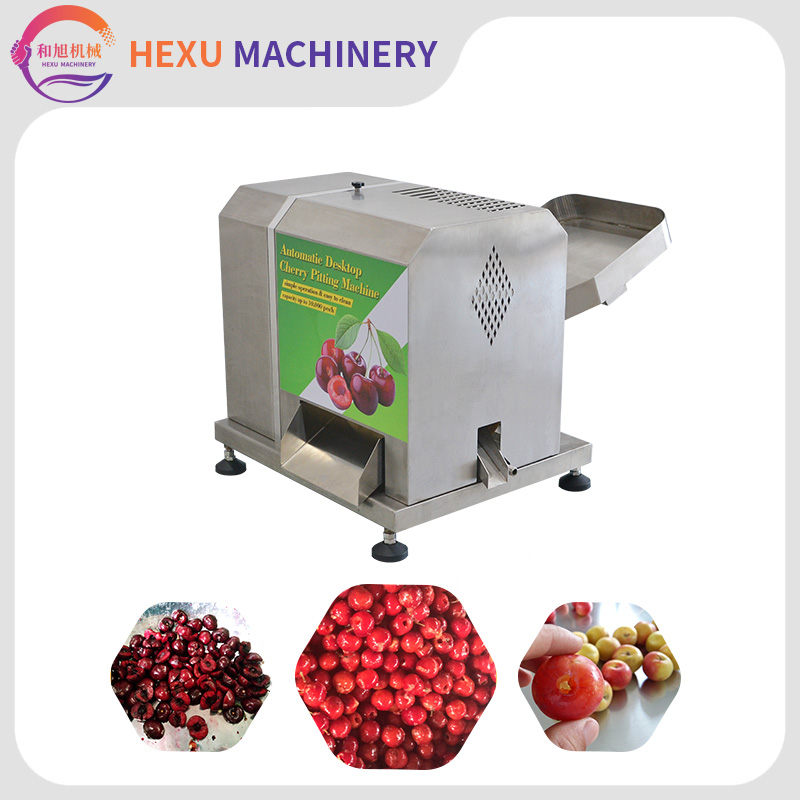
Why Automatic Cherry Pitting Matters
Pitted cherries are widely used in frozen fruit, canned products, preserves, bakery fillings, beverages, confectionery, sauces, and ready-to-eat desserts. In these applications,
processors need to remove the stone while keeping the fruit as intact as possible. Excessive tearing can reduce visual quality, increase juice loss, and make the fruit less suitable
for premium products.
The USDA standards for frozen red tart pitted cherries demonstrate that pitted cherries are an established commercial product category with defined expectations for appearance
and defects. Consistent pitting is therefore not only about speed; it also supports repeatable product quality and easier downstream processing.
Unlike manual cherry pitters that depend heavily on operator technique, the QH-C machine feeds and processes each fruit individually. Its precision pitting system is designed to
leave only a small opening after the stone is removed, helping preserve the cherry’s shape and appearance.
Compact Size with High Output
The machine measures approximately 600 × 610 × 600 mm, making it suitable for small processing rooms, central kitchens, pilot plants, bakery preparation areas, and seasonal
fruit-processing workshops.
Despite its compact footprint, it can process up to 10,000 cherries per hour under suitable operating conditions. Continuous operation allows small and medium-sized processors to
achieve significantly higher throughput than manual pitting.
Actual capacity may vary according to fruit size, ripeness, feeding consistency, mold selection, and operating conditions.
Automatic Feeding and Individual Pitting
The automatic feeding system moves cherries into the processing position, where each fruit is handled separately. This controlled method improves alignment between the cherry, mold, and
pitting pin.
Correct positioning is important because poorly centered fruit may be damaged, leave part of the pit behind, or develop an unnecessarily large opening. The QH-C is designed to guide each
cherry through a repeatable pitting cycle, helping processors achieve a more uniform finished product.
Businesses requiring other capacities or fruit applications can explore Hexu Machinery’s complete range of fruit pitting machines.
Quick-Release Molds for Different Fruit Sizes
Fruit size can vary between varieties, farms, seasons, and grading standards. A fixed mold may reduce accuracy when the processor changes to a larger or smaller cherry.
The QH-C uses a quick-release mold structure that allows operators to replace molds with different diameters. Available options include 25, 30, 35, and 40 mm. Selecting a mold close to the
actual fruit diameter helps improve positioning and reduce unwanted movement during pitting.
The interchangeable design also gives the machine broader application potential. Depending on fruit size, firmness, and pit structure, it can be configured for cherries, longan, small plums, and
frozen bayberry.
Processors working with specific fruit varieties can also review the Longan Pitting Machine and the larger Plum Coring Machine.
Pitting Only or Pitting and Cutting
Different products require different finished forms. Whole pitted cherries may be preferred for frozen packs, garnishes, confectionery, preserves, and premium desserts. Halved cherries may be more
suitable for bakery fillings, fruit mixes, drying, sauces, toppings, and further inspection.
Two pitting-pin configurations are available:
Pitting only: Removes the stone while keeping the fruit substantially whole.
Pitting and cutting: Removes the stone and cuts the fruit during the same processing cycle.
Combining pitting and cutting can simplify the production flow and reduce additional handling. The most suitable pin depends on the final product, fruit firmness, and required appearance.
For example, a processor producing premium frozen cherries may prefer the pitting-only configuration, while a bakery filling manufacturer may select the pitting-and-cutting option to simplify the
next production stage.
304 Stainless Steel and Easier Cleaning
The machine body is constructed from 304 stainless steel for strength, corrosion resistance, and suitability for food-processing environments. The washable processing section can be cleaned
directly with water after use, while the motor and electrical components must be protected from direct spraying.
Hygienic equipment design is especially important in fruit processing because cherry juice, pulp, skins, and sugar residues can collect around difficult-to-clean areas.


